

About Mahler Symphony 1 and its Funeral March
The third movement of Mahler Symphony 1 is one of the strangest pages in the symphonic repertoire: a funeral march built on the children’s round “Frère Jacques”, which Mahler called “Bruder Martin”, played in D minor. Over a soft timpani beat, a solo double bass begins the canon; bassoon and tuba follow, and the round gradually spreads across the whole orchestra.
Mahler composed the symphony mainly between late 1887 and March 1888 and conducted the premiere in Budapest on 20 November 1889. The nickname “Titan” comes from the Hamburg (1893) and Weimar (1894) performances; Mahler later dropped it, together with the programme and the “Blumine” movement. In that programme, the movement was described as a funeral march “in the manner of Callot”.
Again and again the procession is interrupted by a village band of oboes, clarinets, trumpets, cymbals and bass drum, marked “Mit Parodie”. In the middle, the music turns to G major and quotes “Die zwei blauen Augen”, the last of Mahler’s “Lieder eines fahrenden Gesellen”: a moment of tenderness before the march returns.
About this Mahler Symphony 1 piano trio arrangement
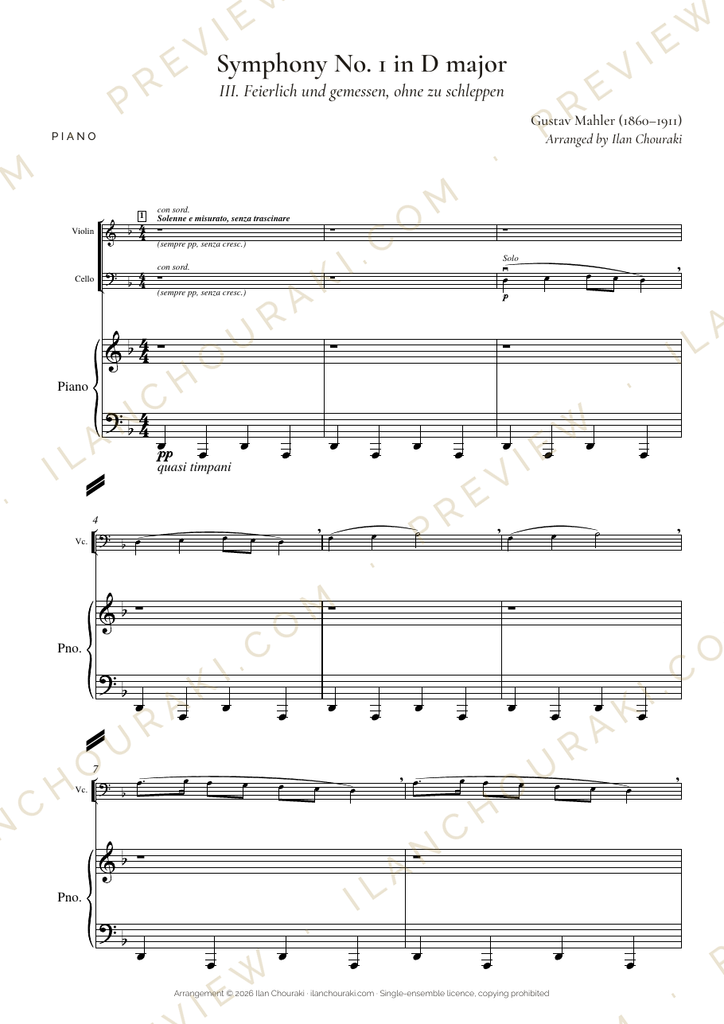
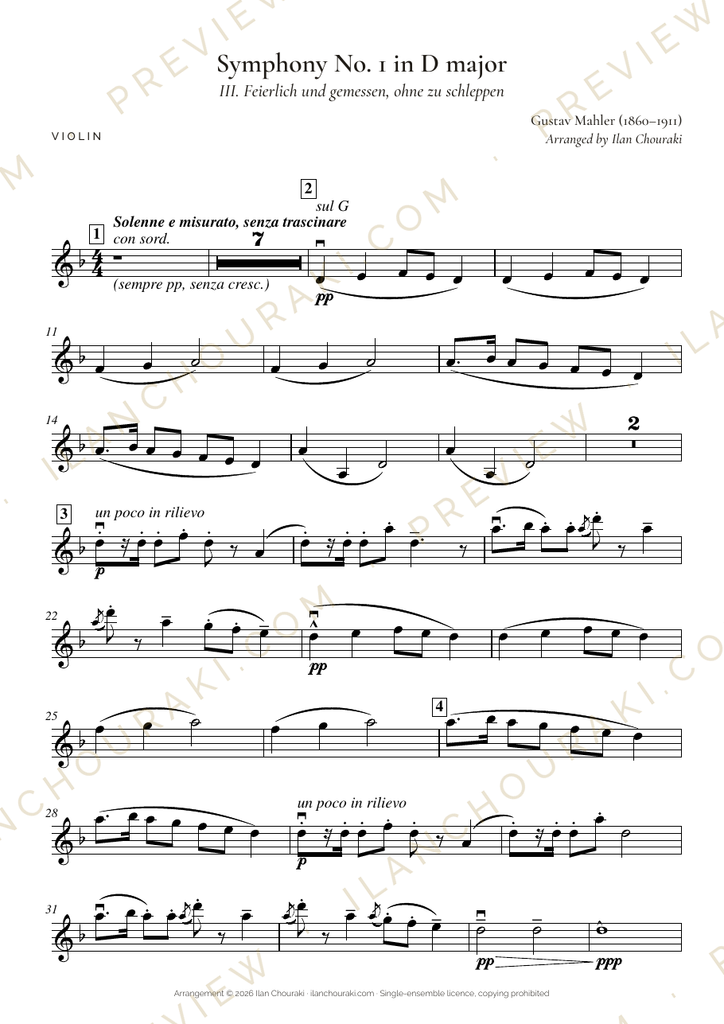
This reduction follows Mahler’s full score (Universal Edition, U.E. 2931) bar by bar: all 168 bars, with the original bar numbers and rehearsal figures 1 to 19. The cello opens the canon, as Mahler’s solo double bass does, and later sings the trumpet melodies an octave lower. The violin takes the bassoon, oboe, E-flat clarinet and first-violin lines, including the theme “sul G” and the parody episodes. The piano carries the timpani ostinato, the harp and the other voices of the canon.
Every note was checked against the orchestral score of Mahler Symphony 1. Where a line comes from Mahler’s strings, his own slurs, bowings and dynamics are kept; lines taken from the winds are phrased for the bow. Tempo and expression marks are given in Italian for international players. It is an ideal way to bring Mahler Symphony 1 into a chamber music programme.
What’s included
- Pianist’s score with the violin and cello parts cued above the piano (24 pages of music in A4)
- Separate violin and cello parts (6 pages each), with page turns placed in rests and marked “V.S.”
- Each file in A4 and US Letter, with a printable cover
- Engraved for comfortable reading: 8 mm staves for the strings, 7 mm for the piano
See also our Mahler Symphony 2 piano trio: the Scherzo of the “Resurrection” Symphony, arranged in the same way.
Frequently asked questions
What level is this Mahler Symphony 1 piano trio? Advanced: for conservatory students and professional piano trios. The tempo is slow, but the movement asks for a singing tone, quiet control and a sharp sense of irony. Is this the complete third movement of Mahler Symphony 1? Yes. Nothing is cut: the canon, the band episodes, the G major song and the coda are all there. How long is the movement? About 11 minutes. Where can I see the orchestral score? The full score is in the public domain on IMSLP. Can I play it from a tablet? Yes: use the A4 PDFs directly, one file per musician.
Performance notes
- Piano, left hand: the D–A ostinato stands for Mahler’s timpani and pizzicato double basses (“quasi timpani”).
- “quasi arpa”: harp writing adapted for the keyboard.
- Pedal: none marked, as in Mahler’s score; at the pianist’s discretion.
- Mutes: time is allowed to fit or remove them; after col legno, “ord.” restores normal playing.
- Bowing: one editorial bowing only, shown with dashed slurs (cello, bars 87–89).
- Ending: in the symphony, the movement leads straight into the finale (attacca); this edition ends on the final pianissimo, ready for concert performance on its own.
Details
| Composer | Gustav Mahler |
| Work | Symphony No. 1 in D major, III. Feierlich und gemessen, ohne zu schleppen |
| Instrumentation | Violin, Cello, Piano |
| Duration | c. 10–11 min |
| Format | 3 PDF files (score + 2 parts) in A4 and US Letter, instant download |
| Arranger | Ilan Chouraki |
Single-ensemble licence: for the use of one ensemble (study, rehearsal and performance). See the Licensing & Usage Policy.