

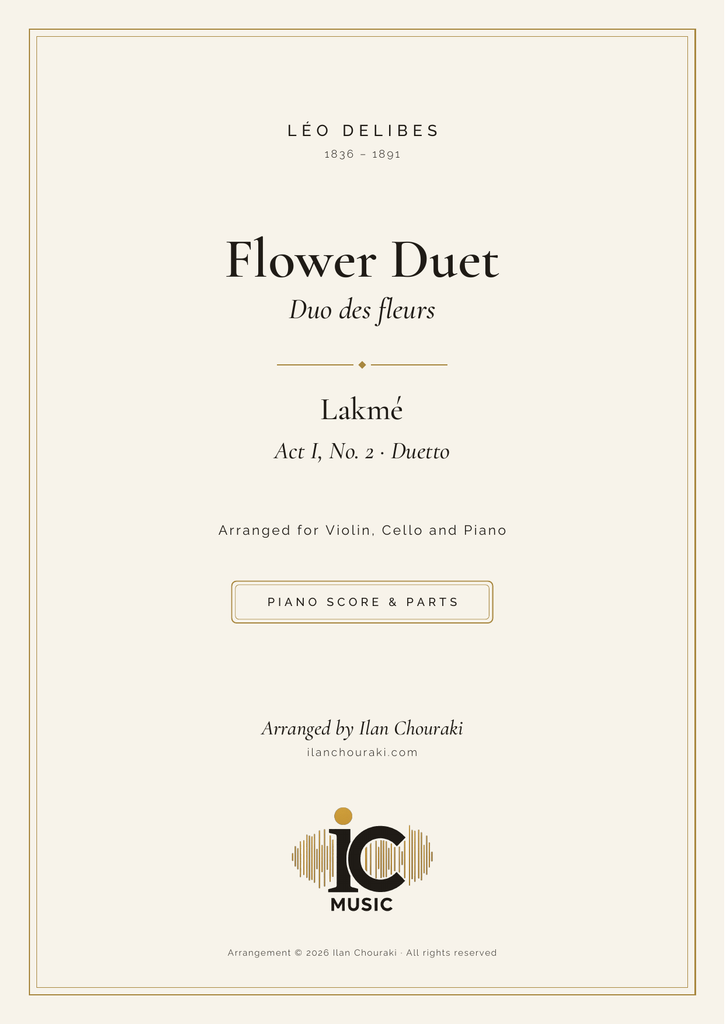
About the Delibes Flower Duet
The Delibes Flower Duet is one of the most beloved pages in French opera. It comes from Lakmé, Léo Delibes’ opera in three acts on a libretto by Edmond Gondinet and Philippe Gille, first performed at the Opéra-Comique in Paris on 14 April 1883. In the first act, Lakmé, the daughter of a Brahmin priest, and her servant Mallika go down to the river to gather flowers, and their two voices intertwine in the duet “Sous le dôme épais”.
Delibes (1836–1891), already celebrated for the ballets Coppélia and Sylvia, wrote Lakmé at the height of the French taste for exotic subjects. The title role was created by the American soprano Marie van Zandt, and the opera reached its 1,000th performance at the Opéra-Comique in 1931.
The scene opens with a short, lively dialogue, “Viens, Mallika, les lianes en fleurs…”. Then the famous melody floats in a gently rocking 6/8, the soprano and the mezzo-soprano weaving around each other in thirds and sixths. A more agitated middle section, in which Lakmé confesses a sudden fear for her father, leads back to the opening melody before the two voices fade away together.
Far beyond the opera house, the Delibes Flower Duet became famous through advertising, notably the British Airways commercials of the 1980s, and through its use in films.
About this Delibes Flower Duet piano trio arrangement
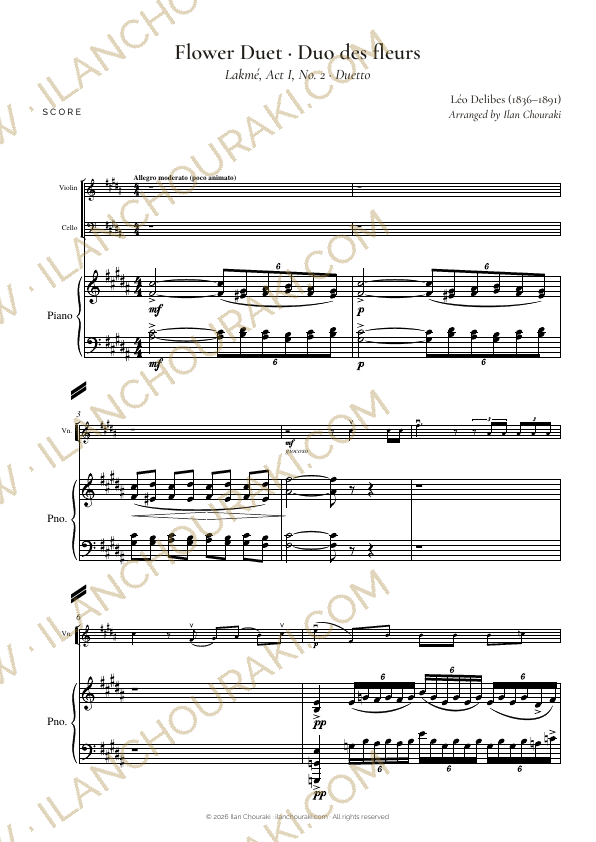
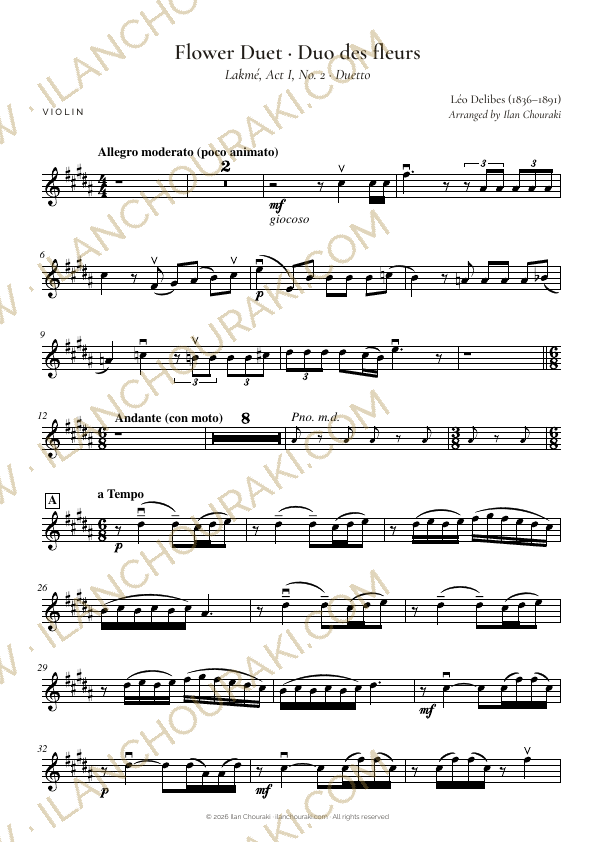
This arrangement presents the complete number, Act I, No. 2 of Lakmé: all 111 bars, from Lakmé’s call to Mallika to the final chord, with the bar numbers and rehearsal letters of the full score (Heugel, Paris). The violin plays Lakmé’s line at written pitch and the cello plays Mallika’s line an octave lower, so the two voices keep their dialogue, their parallel thirds and their crossings. The piano is a reduction of Delibes’ orchestra: it carries the accompaniment and never doubles the voices.
The bowings are the editor’s: slurs follow the sung phrases and melismas, and repeated syllables on one pitch are played louré. Tempo marks are those of the full score, given in Italian. It is an ideal way to bring the Delibes Flower Duet into a chamber music programme, a recital or a wedding ceremony.
What’s included
- Pianist’s score with the violin and cello parts cued above the piano
- Separate violin and cello parts, with page turns placed in rests and marked “V.S.”
- Each file in A4 and US Letter, with a printable cover
- Engraved for comfortable reading: 8 mm staves for the strings, 7 mm for the piano, cue notes after long rests
See also our Nutcracker Pas de Deux piano trio: the grand Pas de deux of Tchaikovsky’s ballet, arranged in the same way.
Frequently asked questions
What level is this Delibes Flower Duet piano trio? Intermediate: lyrical lines in comfortable positions for the strings (the cello reads tenor clef in places) and a moderate piano part.
Is this the complete Flower Duet? Yes: the complete No. 2 of Lakmé, including the opening dialogue, without a single cut.
Who plays which voice? The violin is Lakmé (soprano); the cello is Mallika (mezzo-soprano), an octave lower.
How long is the piece? About 4½ to 5 minutes.
Where can I see the orchestral score? The full score of Lakmé is in the public domain on IMSLP.
Can I play it from a tablet? Yes: use the A4 PDFs directly, one file per musician.
Performance notes
- Voices: the violin plays Lakmé’s line at written pitch; the cello plays Mallika’s line an octave lower, in tenor clef for the high passages.
- Bowings: editor’s (Delibes wrote for voices): slurs follow the melismas; repeated syllables on one pitch are played louré.
- Dynamics: a few dynamics missing from the vocal lines at an entry are added in the strings (editor).
- Pedal: the Ped. marks are taken from the vocal score.
- (Cor.) in the piano part marks a horn call of the orchestral score.
- Ending: in the opera, the scene continues; this edition ends on the duet’s final chord, ready for concert performance on its own.
Details
| Composer | Léo Delibes |
| Work | Lakmé, opera in three acts (1883), Act I, No. 2, Duo “Sous le dôme épais” (Flower Duet), Allegro moderato (un peu animé) – Andante (con moto) |
| Instrumentation | Violin, Cello, Piano |
| Duration | c. 5 min (111 bars) |
| Format | 3 PDF files (piano + 2 parts) in A4 and US Letter, instant download |
| Arranger | Ilan Chouraki |
Single-ensemble licence: for the use of one ensemble (study, rehearsal and performance). See the Licensing & Usage Policy.